

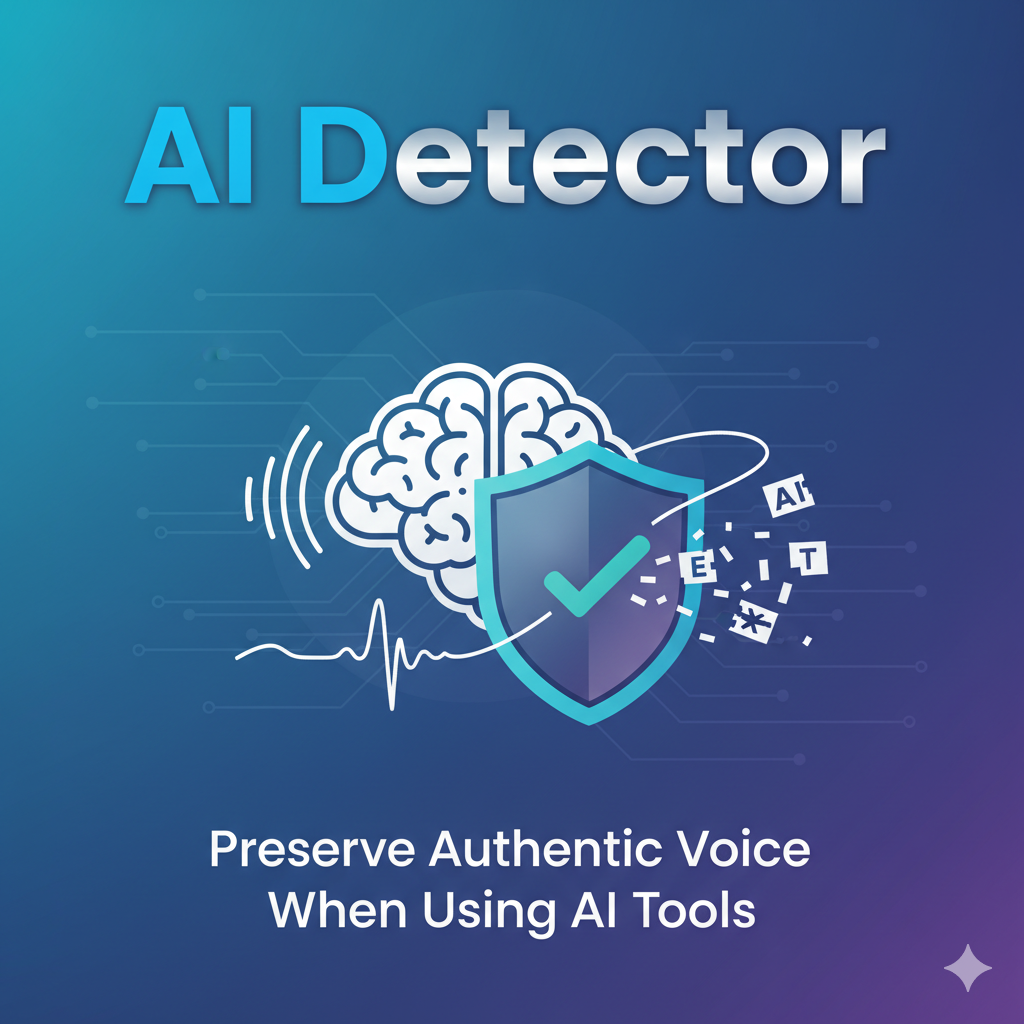
AI Detector: Preserve Authentic Voice When Using AI Tools
Imagine walking into a café where everyone suddenly starts reciting perfectly measured sentences: polite, polished, and eerily similar. The charm of conversation — the awkward pauses, the sudden jokes, the partial sentences that reveal character — is gone. That’s the quiet danger of unmoderated machine-written content. The AI detector is the little bell that alerts you when the café has been taken over.
This isn’t about policing; it’s about preserving flavor. An AI detector helps you decide when to keep the machine’s help and when to insist on a human touch.
A different kind of proof: linguistic fingerprints
An AI detector doesn’t read for facts like a fact-checker. Instead, it scans for traces — the tiny habits a model develops when it stitches words together. Those habits aren’t errors. They’re patterns: a certain evenness of sentence length, a tendency to favor neutral expressions, or overly tidy transitions where a human might dart off on a tangent.
Think of those traces as the grain in wood. A piece of wood with a perfect, uniform grain looks manufactured. The detector shows you where the grain is too uniform, reminding you to restore knots and personality.
Practical uses that actually change outcomes
Let’s skip the abstract. Here are three places an AI detector makes immediate, practical differences:
• Product pages: When descriptions read like a brochure template, conversion drops. A detector flags the templated parts so product teams can add a concrete detail — a scent, a sound, a small user quote — that sells.
• Candidate screening: Recruiters often receive refined, polished cover letters. Run them through a detector to find which ones reflect genuine voice versus replicated phrasing, then ask one follow-up question to test original thinking.
• Editorial gates: Before publishing op-eds or guest posts, editors can use detection feedback to decide whether to request a quick audio clip or a personal anecdote that proves authorship.
These aren’t punitive steps. They’re editorial moves that restore texture.
How to respond to a flagged passage (3 quick edits)
If the detector highlights a paragraph, use this micro-process to humanize it fast:
-
Add an incident: Insert a one-sentence, specific moment (a time, a place, a small conflict).
-
Break the rhythm: Rewrite one sentence to be intentionally shorter or longer than the rest. Imperfect pacing feels alive.
-
Name something real: A product model, a local coffee shop, a precise number — exactness cuts through generic phrasing.
These edits cost little and add a lot of trust.
Why detection should be transparent, not secretive
Brands that quietly use AI risk losing trust when audiences find out later. A better play: acknowledge AI’s role and emphasize human oversight. A short line — “Drafted with AI tools, crafted by our editorial team” — signals honesty and confidence. It also reduces the temptation to game detection systems by over-stylizing text to mimic “authenticity.”
When detectors get it wrong (and what to do)
Like any tool, detectors produce false positives. A highly practiced writer who favors clarity might look machine-made. When that happens, don’t ban content; verify it. Ask for context, a short voice note, or a draft with comments. Use detection as a conversation starter, not an executioner.
The long-term benefit: better brief-writing
One unexpected effect of frequent detection is improved briefs. When teams know AI will be checked, they start feeding tools smarter prompts: more constraints, clearer audience signals, and requests for local color. In other words, detection forces better inputs — which produces higher-quality outputs whether the final author is human, machine, or both.
A final, strategic note
The most effective use of a KI detector is not to eliminate machine help but to manage it. Machines are excellent at generating first drafts, summarizing research, and producing consistent documentation. Humans are better at injecting judgment, surprise, and moral perspective. The smartest teams use detectors to divide labor — machines for scale, humans for soul.
For More Blogs: Click Here
Catégories
- People and Nations
- Transport and Mobility
- Climate Adaptation
- Business and Ecommerce
- Climate Startups
- Climate Policy
- Energy
- Nature and Wildlife
- Food
- Sustainability
- Innovation
- Health
- Climate Justice
- News and Politics
- Climate Finance
- Agriculture
- Research and Education
- Livability
- Climate Cities
- Science
- Sports
- Carbon
- Wellness
- Climate Change General
- Environment and Wildlife Conservation
- Coastal and Oceans
- Manufacturing and Materials
- Pollution
- Climate Mitigation
- Climate Conferences and Events
- Land and Soil
- Youth in Climate
- Weather and Disasters
- Greenhouse effect
- Recycling and Waste management
- Climatexi
- How To
- Products and Services
- Storytelling
Lire la suite
"Executive Summary: 2D Transition Metal Carbides Nitrides Market Market Size and Share by Application & Industry CAGR Value The global 2D transition metal carbides nitrides market size was valued at USD 179.40 million in 2024 and is expected to reach USD 1042.23 million by 2032, at a CAGR of 24.60% during the forecast period Market growth is...

The tea industry has been evolving rapidly due to changing consumer preferences, increased demand for high-quality products, and technological innovation in processing methods. Sorting is a critical step in tea production, as it ensures uniformity, enhances flavor consistency, and improves the overall visual appeal of the product. Automated tea sorting machines have become integral to modern...
Other hits included a floral skirt, Vogue editor approved ballet flats, a novelty cap, and a very casual rare ldsbag.com green shopper bag from the house's fall runway. Whether Gaga commissioned the or it was gifted to her remains a mystery, but one thing is for sure: The resemblance is uncanny. She added a touch with a pair of rectangular sunnies. The gown fell into a peplum column with...

"Global Demand Outlook for Executive Summary Plastic Dielectric Film Market Size and Share The plastic dielectric film market size was valued at USD 1.27 billion in 2024 and is projected to reach USD 1.77 billion by 2032, with a CAGR of 4.20% during the forecast period of 2025 to 2032.This Plastic Dielectric Film Market report includes a wide-ranging evaluation of the market’s...
"In-Depth Study on Executive Summary Specialty Polystyrene Resin Market Size and Share 2021-2028. This concludes that the speciality polystyrene resin market is bound to witness a CAGR of 2.57% around for the forecast period. The world class Specialty Polystyrene Resin Market business report presents with the continual knowledge and information of transforming market landscape,...