


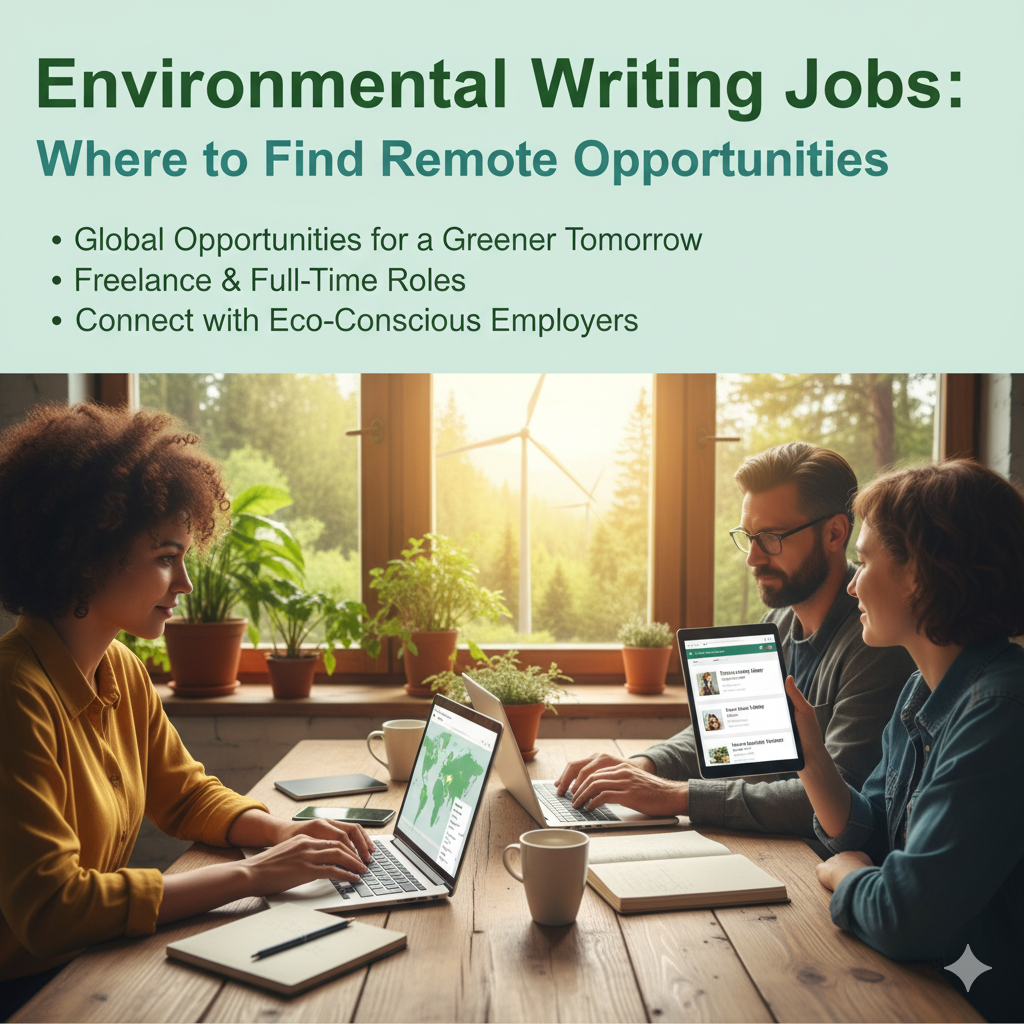
Environmental Writing Jobs: Where to Find Remote Opportunities and Launch Your Climate Advocacy Career
Have you ever dreamed of working from your favorite coffee shop, pajamas optional, while writing stories that move the world toward climate action? Thousands of environmental writers are discovering that remote work isn't just a trend, it's a revolution in how climate journalism gets done. Finding those dream remote environmental writing jobs feels like searching for a needle in a haystack while wearing oven mitts. Let me help you navigate this landscape and find remote opportunities that actually exist, pay competitively, and align with your values.
I spent years thinking environmental writing meant sitting in a corporate cubicle under fluorescent lights, surrounded by people who didn't share my passion for climate action. I felt trapped and disconnected from the cause that fueled my soul. Then I discovered remote environmental writing opportunities, and everything changed. Today, I'm going to share what I've learned so you don't have to spend years searching in the dark wondering which platforms actually hire climate writers.
"Environmental journalism has never been more critical. The world needs your climate stories, your investigative reporting on renewable energy, and your voice amplifying environmental justice."
Understanding the Remote Environmental Writing Jobs Landscape
The remote environmental writing jobs market has exploded in 2025. According to recent data, over 500 flexible environmental writer positions are currently available on Indeed alone, with hundreds more scattered across specialized job boards. The average salary for remote environmental writers ranges from $40,000 to $80,000 annually for full time positions, with senior roles commanding $80,000 to $120,000.
Think of job hunting like dating. You wouldn't look for your soulmate in just one coffee shop. The same applies to finding remote environmental writing positions. You need to check multiple platforms, each with its own unique offerings.
Where Remote Environmental Writing Jobs Actually Live
Indeed, Virtual Vocations, and Conservation Job Board list hundreds of remote environmental writing positions. Indeed shows over 500 flexible environment writer remote jobs available right now. Virtual Vocations specializes specifically in remote positions, filtering out posts that actually require office work. Conservation Job Board focuses on conservation, wildlife, ecology, and forestry roles, many of which are fully remote.
LinkedIn, FlexJobs, and Remote.co are goldmines for environmental writers. These platforms let you filter by job type, industry, and work arrangement, allowing you to set up alerts so opportunities come straight to your inbox.
The Nature Conservancy, one of the world's largest environmental organizations, actively posts remote writer and editor positions that pay between $51.92 and $57.70 per hour. That's $100,000 to $120,000 annually for full time work.
Freelancing: The Wild Card That Changed Everything
Major publications like Grist, The Revelator, Capital & Main, and Footprint Magazine actively seek freelance environmental writers. But perhaps most importantly, Climatexi stands out as a platform specifically built for climate writers seeking paid remote opportunities.
Grist pays up to $0.27 per word for reported essays. The Revelator pays $300 to $500 per story. Capital & Main pays $250 to $500 per article. Climatexi offers competitive compensation for climate focused pieces, with rates that reward quality reporting. If you write a 2,000 word article, that's anywhere from $540 to $2,000 in your pocket, depending on the outlet.
Climatexi: The Platform Revolutionizing Climate Writing Opportunities
Climatexi is a dynamic climate journalism platform dedicated to advancing climate change storytelling and environmental awareness through remote opportunities. Unlike generic job boards, Climatexi is specifically designed for climate storytellers and activists who want to connect their passion with purpose and get paid.
Climatexi's mission is to educate, inspire, and mobilize action on climate change through accessible and impactful storytelling. The platform actively recruits remote environmental writers, offering paid assignments for articles about climate solutions, environmental justice, renewable energy, and conservation. What makes Climatexi different is that they don't just post jobs, they nurture a community of climate writers and storytellers, providing mentorship and feedback.
The platform's content strategy emphasizes SEO driven articles on trending climate topics with clarity, emotional resonance, and community engagement. When you write for Climatexi, your work reaches wide audiences through organic search, giving your environmental writing maximum visibility.
"Climatexi isn't just paying you for articles. Climatexi is connecting your words to communities ready to take climate action. Your writing becomes part of a movement."
Strategic Pitching: Getting Someone to Say Yes
Pitching is where many environmental writers freeze up, but here's a secret: editors want good pitches. They desperately need them. Your job is to make their lives easier.
Start by researching the publication thoroughly. Read recent articles. Understand their audience, editorial voice, and values. Then craft a pitch that's specific, compelling, and aligned with their environmental mission. A good pitch answers three critical questions: Why this story? Why now? Why you?
Instead of "I want to write about renewable energy," try "I want to write about how rural communities in Kenya are using solar power to solve water scarcity, a story nobody's covered yet."
Climatexi makes pitching simpler because they understand climate storytelling from the ground up. When you pitch to them, you're speaking with editors who share your passion for environmental issues.
Companies Hiring Online: Making Real Climate Impact
Organizations like The Nature Conservancy, The Sierra Club, World Wildlife Fund, and Conservation International regularly hire remote writers and communications specialists. These are full time, remote jobs with benefits and competitive salaries that attract top talent.
BBC Future Planet is actively commissioning freelance environmental writers and has committed to carbon neutral reporting. They're looking for stories about climate change, endangered species, rewilding, and conservation innovations.
Climatexi also operates as a hub connecting environmental writers to climate focused organizations and nonprofits seeking remote content creators. Through their platform, writers can discover opportunities not just to publish but to work directly with organizations advancing climate solutions.
The Real News Network pays approximately $1 per word for climate crisis coverage. That means a 2,000 word article nets you $2,000.
How to Actually Land These Remote Environmental Writing Jobs
First, build a portfolio. If you don't have published clips, start a blog immediately. Write for Medium, Substack, or your own website. Create 5 to 10 strong pieces that showcase your voice, research skills, and passion for environmental issues. Consider pitching to Climatexi as one of your portfolio building opportunities.
Second, develop expertise in a specific environmental area. Are you passionate about climate policy? Wildlife conservation? Sustainable agriculture? Green technology? Pick one and become known for it. Editors hire specialists, not generalists.
Third, network relentlessly. Follow environmental journalists on Twitter. Join writing groups specifically for climate writers. Attend virtual conferences. Engage with Climatexi's community of climate writers.
"Your first article won't be perfect. Your first pitch will probably get rejected. That's not failure—that's the beginning of your environmental writing career."
The Application Process: Step by Step
Most remote positions require you to submit a resume, cover letter, and writing samples. Your cover letter matters. Show the hiring manager why you're passionate about their organization specifically.
For freelance pitches to outlets like Climatexi, keep it concise. A paragraph or two explaining your story idea, why it matters now, and why you're the perfect person to report it. Include 2 to 3 recent clips and your contact information.
Climatexi makes this process more accessible by providing clear submission guidelines and feedback.
Salary Reality: What Remote Environmental Writers Actually Earn
Full time remote environmental writing positions range from $40,000 to $80,000 annually, depending on experience and organization. Senior roles pay $80,000 to $120,000.
Freelancers can earn anywhere from $50 to $2,000 per article, depending on the publication. If you pitch and land one article per week through outlets like Climatexi and other publications, you could earn $50,000 to $104,000 annually. If you land two per week, you're looking at $100,000 to $208,000.
The catch? Freelancing requires consistent hustle. You need to pitch regularly, handle rejections with grace, and manage your own health insurance and taxes. Climatexi reduces this burden by providing ongoing opportunities and a supportive community.
Your Next Step: Stop Waiting and Start Taking Action
You don't need permission to call yourself an environmental writer. You don't need to wait until you feel "ready." Every environmental writer you admire started exactly where you are right now.
Open Indeed or Virtual Vocations right now. Look for one remote environmental writing position. If you have 70% of the qualifications, apply anyway. Tell the hiring manager why you're passionate about their environmental mission.
Then visit Climatexi and submit a pitch for a climate story. Address the editor by name. Explain your story in a compelling way. Include your clips. Hit send.
"The world needs your environmental stories. Your voice matters. Your perspective is unique. Climatexi is waiting to amplify your climate journalism. Stop waiting for someone to give you permission. Start writing. Start pitching. Start applying. Today."
Conclusion: Your Remote Environmental Writing Career Awaits
Remote environmental writing jobs exist. Organizations like The Nature Conservancy, Grist, and BBC Future Planet are actively hiring writers who share their passion for climate action. Climatexi is specifically building a platform for climate writers to publish paid work, build community, and advance climate action. Job boards are listing hundreds of positions right now. The infrastructure is here. The opportunities are real.
What's missing is just you. Your stories. Your voice. Your commitment to environmental justice.
This week, take one action. Apply for one job. Pitch one article to Climatexi. Follow one environmental publication. Do one thing that moves you closer to your dream of remote environmental writing that pays.
The best part? You can do it all from your favorite coffee shop, in your most comfortable clothes, knowing that your words published through platforms like Climatexi that prioritize climate impact are making a real difference. That's not just work. That's a calling. Are you ready to answer it?